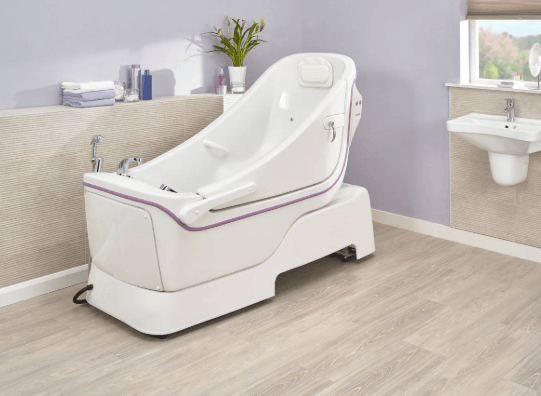
Bathrooms are among the most hazardous rooms in the home, with most accidents occurring when people with mobility problems, the elderly and people with injuries attempt to move around in and around the bathroom. The wet, hard and cramped area of most bathrooms have not been designed with safety and accessibility in mind.
A bathroom can be the most hazardous room in the house but there are many products on the market to make your bathroom safe and that look good too. Realizing that there are products available that deal with specific safety issues is the first step to creating a safe bathroom.
Strategic placement of grab rails
Grab rails. A simple product that can be very effective in bathrooms. If chosen and fitted correctly they can be used for years without any problems. First of all consider the location of the grab rail in the bathroom. The most obvious place to fit a grab rail in the bathroom would be next to the toilet. For use by anyone sitting down on the toilet the top of the grab rail should be at a height of 33-36 inches (83-91cm) off the floor. In addition to this the grab rail should extend 12 inches (30cm) or more beyond the front edge of the toilet bowl. This will enable users of the toilet to sit on the toilet and also use the grab rail for support whilst standing up from the toilet. The shower area also requires grab rails. In the case of a shower the best grab rail to use is a horizontal one. These are fixed to the back of the shower and are at a height of 33-36 inches (83-91cm) off the floor. A vertical grab rail can also be installed near the entrance to the shower. These can be very effective in assisting users to enter and exit the shower safely.
Grab rails that are fitted alongside toilets should be at a height of 33-36 inches from the floor, extending a minimum of 12 inches out from the front of the toilet bowl. This means that the user can sit down and stand up from the toilet and also use the grab rail for added support if required. Ideally grab rails in shower areas should be horizontal and positioned along the back of the shower. This should be at a wall height (33-36 inches from floor level) and there should also be a vertical grab rail positioned immediately adjacent to the entrance to the shower.
Wall types also need to be considered when choosing a grab rail for your bathroom. If you have solid timber or masonry walls then normal screw fixings are usually sufficient. Grab rails should be fixed into the wall at a height of around 33-36 inches from the floor and should extend 12 inches or more from the front of the toilet. For shower or bath areas a horizontal rail is generally the best, fixed along the back wall at a height of around 33-36 inches. A vertical rail is also recommended to be positioned near the entry/exit point of the shower.
The most important aspect of a grab rail is the fixing of the grab rail to the wall. The fixing must be strong enough to withstand the greatest force that is expected to act upon it. If a grab rail is not fixed in such a way that it has got the correct support then it can easily come loose at the worst moment which can lead to serious injury.
Raised toilet seats
Raised Toilet Seats are one of the simplest and cost effective solutions available for using the toilet on a day to day basis. Raised Toilet Seats can be raised from as little as 50mm up to 150mm higher than average toilets to aid people with mobility problems and can be used on a temporary basis by fitting over the top of an average toilet bowl.
A raised toilet seat is a simple solution, which fits on top of the toilet bowl. They can be a simple, disposable product that can be clamped on the toilet and then taken off when no longer required. There are also more fixed options, that have strong plastic or fiberglass that is fixed to the toilet pan. There are also whole toilets that are complete safety toilets with a raised seat, that can be a complete replacement for your existing toilet.
See also: How Technology Is Revolutionizing Healthcare Diagnostics
Shower seating options
Seated in the shower can help people with lots of energy and good mobility to have lots of energy too- for longer! There are many styles of plastic seats that are put on the floor of showers and usually have back rests and arm rests and have an open top to allow water to pour down on the bather. It is wise to look for shower chairs that fit your type of shower. Some models of seats have non slip feet on the bottom of the legs, and some have back rests and arm rests, and some have drainage holes in the seat to allow water to drain from the seat and some even have arms that go up on each side and fold down when not in use.
Transfer benches can be used by disabled individuals that have problems lifting their legs up over the side of a bathtub. There are different designs to fit various bathtubs. Some designs are fixed in place in the bathtub whereas others are freestanding. Transfer benches are typically used by individuals who have difficulties standing up from a seated position on the floor. A major consideration when purchasing a transfer bench is the weight capacity of the product. It is essential that the product chosen has the ability to hold the weight of the individual using it plus at least 50% in order to guarantee safe use by the individual.
Walk in shower seating is available for use with fixed head shower units. The most popular type of seating for use in walk in showers is a wall mounted fold-down seat. These are ideal for small showers as the seat folds up against the wall when not in use, therefore not taking up floor space. The wall mounted fold-down seat is fixed into a solid wall and is the cleanest and most hygienic form of seating for a walk in shower. Transfer benches are ideal for use in and around bathtubs. These allow users to transfer from a wheel chair to the bathtub for safe and comfortable washing. A key feature of a transfer bench is the weight capacity, which must exceed the user’s weight by at least 50% to allow for safe use. There are many different designs of shower chairs on the market, the most versatile type is the chair with height-adjustable legs. This type of shower chair can be used by different people in different shower areas, as the height of the seat can be adjusted to suit. In addition, many shower chairs now come equipped with drainage holes in the seat of the chair to stop water collecting and also with non-slip feet to stop the chair moving around the shower.
Make sure the seats you choose have drainage holes in the seat to prevent water accumulating. Also make sure the feet of the chairs are non-slip so that they do not move whilst in use.
Beyond the basics
A hand-held shower head, a wall-mounted sliding shower rail with long hose of at least 1.5m length allows you to move around safely while showering enabling you to wash safely and independently.
There are also a number of other additional products which can also increase the non-slip surface of a bathroom floors. These can be short term adhesive strips or a long lasting durable and attractive non-slip coating. There are also Rubber mats with suction cups which can be placed at the bottom of a bath. These mats must be regularly cleaned to ensure the suckers on the back of the mat remain in place.
Bathroom aids can be designed to meet the mobility needs of individuals. People who are temporarily disabled and recovering from an operation would have very different needs to those of individuals with a permanent disability. The most effective products are those which have been designed to deal with the ‘day to day’ problems that individual users face.
All items within a bathroom are part of a bigger system to deliver their full safety benefits. For example a grab rail within a bathroom is of little use if a user cannot first get to a shower chair. A raised toilet seat does not offer sufficient support for users who have difficulty standing up from a seated position on a toilet, unless there are suitable support items nearby.
A comprehensive set of bathroom products that can work well if each product is dealing with the most important safety issue for the user. The most important safety issues are often slips and falls or the lack of support for people when they are transferring from sitting to standing. By choosing products to deal with these safety issues, users will find that they form a cohesive and complete system of products, allowing all products to work safely and effectively.
The bathroom is another room in the house and you want your bathroom to look good as well as function well. Remove the obstacles that are making using the bathroom less stressfull and safer for the user. Don’t turn your bathroom into a clinical looking area. Instead, remove the obstacles that make using the bathroom less stressfull and safer for the user.