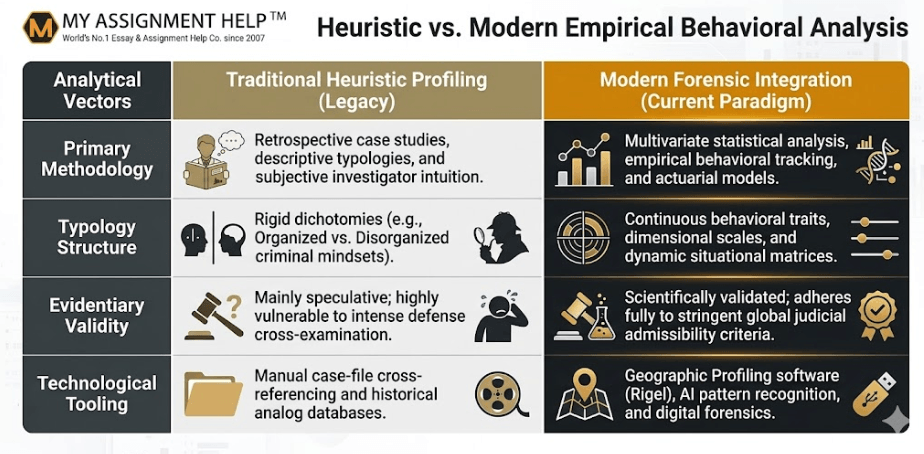
The practice of behavioral analysis within global law enforcement has transitioned from a subjective, intuitive art into a rigorous, data-driven empirical science. Historically, investigative profiling relied heavily on retrospective analyses of specific, high-profile criminal cases, relying on individual instincts and unstructured heuristics. However, twenty-first-century public safety demands quantifiable, structured frameworks that can withstand strict judicial scrutiny within domestic and international courts. Today, law enforcement agencies across Canada—including the Royal Canadian Mounted Police (RCMP) and municipal services—actively integrate advanced empirical methodologies from forensic psychology to dissect criminal intent, optimize field interviews, and predict geographic recidivism patterns.
This fundamental evolutionary shift is rooted directly in empirical research, clinical validation, and advanced psychological profiling frameworks. Modern forensic psychologists operate as foundational elements within active investigation teams rather than auxiliary post-facto consultants. By applying validated psychological matrices, statistical probability models, and rigorous cognitive neuroscience paradigms, professionals decode operational variables to minimize investigator bias, streamline resource deployment, and drastically increase clearance rates for complex, multifaceted offenses.
As academic frameworks expand to meet these rapidly escalating field requirements, Canadian educational institutions have systematically restructured their professional curricula to synthesize quantitative statistical software with behavioral theories. Navigating these rigorous, mathematically dense, and highly theoretical programs creates an unprecedented burden on contemporary criminology and behavioral science students. Consequently, aspiring clinical and field practitioners frequently turn to external academic networks to systematically reinforce their comprehension of complex operational frameworks. Securing professional Psychology Assignment Help allows upcoming legal and behavioral health specialists to systematically parse empirical metrics, master structural profiling paradigms, and successfully bridge the widening gap between classroom theory and real-world tactical applications.
The Historical Architecture of Criminal Profiling
To fully conceptualize contemporary frameworks, one must examine the baseline shift from the Federal Bureau of Investigation’s (FBI) early Behavioral Science Unit (BSU) paradigms established in the 1970s. The traditional dichotomous classification system categorized offenders strictly into “organized” or “disorganized” typologies based on physical crime scene characteristics. While pioneering for its time, this framework was heavily critiqued by the global psychological community for its lack of empirical verification, vulnerability to cognitive confirmation bias, and reliance on static trait psychology.
Modern behavioral analysis rejects these rigid, unscientific dichotomies. Instead, it leverages dynamic behavioral continuity and five-factor personality models to understand criminal variance. Forensic psychology introduces behavioral tracking, which posits that an individual’s operational patterns during an offense directly mirror their day-to-day interpersonal interactions and cognitive schemas. The focus has systematically shifted from identifying why an offender committed a crime to systematically modeling how their behavioral choices throughout the commission of an offense reflect distinct psychological thresholds and decision-making matrices.
Operational Imperative: The transition from descriptive heuristics to investigative psychology ensures that behavioral profiles are generated using standardized behavioral data rather than an analyst’s subjective intuition, rendering evidence verifiable under strict judicial cross-examination.
Empirical Mechanics: Investigative Psychology and Actuarial Models
The modern integration relies heavily on Investigative Psychology, a discipline pioneered to bring objective statistical methods to criminal profiling. Rather than treating each offense as an isolated anomaly, forensic psychology applies rigorous statistical cross-loading. For example, by organizing discrete crime scene actions (e.g., methods of entry, specific verbal demands, binding styles) into behavioral correlation matrices, analysts can determine the statistical probability that an offense is linked to a specific series or a distinct psychological profile archetype.
Furthermore, behavioral analysis extensively utilizes actuarial risk assessments and regression equations to predict escalation. Consider a basic linear behavioral progression matrix used to calculate probability scales of offender escalating behavior:
\mathbf{P(E) = \alpha + \beta_1(V_s) + \beta_2(C_a) – \beta_3(I_t)}
Where:
- \mathbf{P(E)} represents the calculated probability of behavioral escalation.
- \mathbf{V_s} indicates situational vulnerability scores.
- \mathbf{C_a} represents cognitive distortion indicators.
- \mathbf{I_t} acts as situational intervention thresholds.
Through these mathematical models, forensic psychology converts abstract human intent into discrete variables that active-duty police command structures can utilize for predictive resource routing.
Geographic Profiling and Spatial Criminology
One of the most concrete examples of integrating forensic psychology into active law enforcement is geographic profiling. Pioneered by Canadian criminologist Dr. Kim Rossmo, this methodology applies spatial analytics and environmental psychology to locate an offender’s operational anchor points—typically their residence, workplace, or routine activity nodes. By analyzing the precise spatial distribution of serial crime locations, forensic psychologists model the psychological journey of the criminal.
This relies fundamentally on the psychological principle of “distance decay,” which indicates that offenders prefer to operate within a comfortable radius of their anchor point but will maintain a minimal “buffer zone” directly adjacent to their residence to preserve anonymity. Advanced spatial processing algorithms utilize decay functions to generate a three-dimensional probability surface known as a jeopardy surface. This allows law enforcement agencies to prioritize zip codes, patrol patterns, and DNA screening strategies across expansive urban landscapes, optimizing limited tactical resources during high-stakes active investigations.
Cognitive Interviewing Paradigms and Credibility Assessment
Beyond active criminal profiling, forensic psychology has fundamentally revolutionized tactical interrogation. Traditional, high-pressure interrogation techniques aimed at breaking a suspect’s psychological resistance are rapidly being phased out worldwide due to their high statistical correlation with false confessions and flawed investigative leads. Modern police forces utilize the Cognitive Interview (CI) framework and the PEACE model (Preparation, Engage, Account, Clarify, Evaluation).
The Cognitive Interview framework leverages advanced memory-retrieval techniques derived directly from cognitive psychology. Investigators guide witnesses and suspects to reconstruct environmental and personal contexts, report events from varied chronological sequences, and alter spatial perspectives. Empirical validation indicates that this non-confrontational, scientifically structured methodology yields up to 45% more legally accurate information than standard interrogation processes without increasing false positive reporting rates.
Simultaneously, forensic psychologists train investigators in Strategic Use of Evidence (SUE) frameworks. Instead of immediately confronting a suspect with incriminating facts, investigators systematically withhold evidence while evaluating the suspect’s psychological statements against independent digital or physical evidence. This allows deceptive mindsets to create clear, irreconcilable contradictions, establishing objective metrics for credibility assessment that stand up perfectly under judicial scrutiny.
The Academic Pipeline and Tactical Burnout
The implementation of these sophisticated, multidisciplinary frameworks has permanently altered the professional trajectory for law enforcement and legal professionals across North America. To advance into specialized behavioral units, active-duty officers, intelligence analysts, and civilian practitioners must acquire advanced degrees in behavioral science, forensic psychopathology, and quantitative criminology. This academic path requires a deep mastery of complex statistical software, legal precedents, and advanced neurobiological diagnostic manuals.
Balancing relentless, high-stress operational shift work with the stringent demands of advanced academic research programs presents an acute cognitive burden for active first responders and working student professionals. To navigate this extreme dual-responsibility pressure, many forward-thinking students choose to systematically utilize premium external educational support services. The strategic choice to pay for assignment editing, research structuring, and statistical verification allows these critical public safety workers to maintain excellent academic standing. This specialized academic assistance ensures they do not experience profound mental burnout, enabling them to balance intensive operational duties with demanding educational milestones.
Key Takeaways for Modern Practitioners
- Paradigm Transformation: Behavioral analysis has evolved completely from subjective descriptive typologies into empirical, multivariate statistical frameworks.
- Spatial Intelligence: Geographic profiling combines environmental psychology with mathematical decay algorithms to precisely locate offender anchor zones.
- Evidence-Based Interrogation: Cognitive interviewing models have systematically replaced high-pressure interrogation tactics to maximize objective factual accuracy and minimize false confessions.
- Academic Rigour: The continuous advancement of modern behavioral analytics requires ongoing academic upskilling, forcing professionals to actively seek advanced, quantitative research support systems.
See also: How Technology Is Revolutionizing Healthcare Diagnostics
Frequently Asked Questions (FAQs)
1. How does modern forensic psychology differ from historical criminal profiling?
Historical criminal profiling relied heavily on an individual analyst’s intuition and subjective case comparisons. In contrast, modern forensic psychology leverages investigative psychology, applying multivariate statistical matrices, spatial algorithms, and validated psychological behavioral tracking to ensure verifiable, court-admissible results.
2. What role does geographic profiling play in active police investigations?
Geographic profiling uses environmental psychology and mathematical distance decay functions to analyze the spatial footprint of serial crimes. This generates a visual probability matrix that helps law enforcement isolate the offender’s most likely geographic anchor points, such as their residence or workplace.
3. Why is the PEACE model preferred over traditional interrogation techniques?
The PEACE model focuses on non-confrontational, investigative interviewing and information gathering. Grounded in cognitive psychological frameworks, it maximizes the collection of reliable information and minimizes the psychological conditions that can lead to false confessions under pressure.
4. How do behavioral science students effectively manage advanced statistical curricula?
Due to the demanding nature of quantitative behavioral research, many students and active first responders look to external academic support networks. Utilizing specialized, high-tier educational resources helps them balance operational field demands with intense academic research standards.
Empirical References & Academic Sources
- Canter, D., & Youngs, D. (2009). Investigative Psychology: Offender Profiling and the Analysis of Criminal Action. John Wiley & Sons.
- Rossmo, D. K. (2000). Geographic Profiling. CRC Press.
- Fisher, R. P., & Geiselman, R. E. (1992). Memory-enhancing techniques for investigative interviewing: The cognitive interview. Charles C Thomas, Publisher.
- Granhag, P. A., & Hartwig, M. (2015). The Strategic Use of Evidence (SUE) technique: A psychological framework for interviewing suspects. Journal of Investigative Psychology and Offender Profiling, 12(2), 115-131.
About the Author
Dr. Evelyn Vance is a Senior Content Specialist and Academic Consultant at MyAssignmentHelp. She holds a Ph.D. in Forensic Psychology and has over a decade of experience designing specialized educational curricula and content marketing campaigns tailored for criminology, behavioral analytics, and legal studies programs across North America and the United Kingdom.